Arway Logo

exclusive webinar

Live Button

Explore ARway.ai’s Advanced Capabilities:

Navigating New Augmented Reality Experiences

Online • Wed April 24, 2024 • 9AM EST • 3PM CEST

In today’s rapidly evolving digital landscape, technology integrators, XR/AR developers, and digital and marketing agencies are constantly seeking innovative solutions to enhance their service offerings and create new revenue streams. ARway.ai emerges as a powerful partner in this journey, providing a platform that not only revolutionizes client outcomes across various industries but also opens up lucrative new business avenues. This blog delves into the unique value propositions presented by ARway.ai and how they align with the goals and needs of our partners, driving mutual growth and success.

Empowering Your Service Portfolio with AR Solutions

Discover how ARway.ai enriches your service portfolio, enabling you to offer state-of-the-art augmented reality solutions. From retail and real estate to education and public safety, ARway.ai’s versatile platform allows you to cater to diverse client needs, setting you apart from competitors. Discuss the comprehensive range of applications and how they translate into tangible benefits for clients, reinforcing your role as a forward-thinking, solutions-driven partner.

Streamlining Deployment and Integration

For technology and system integrators, efficiency and reliability in deployment are key. Explore how ARway.ai’s intuitive platform streamlines the deployment and integration process, making it faster and more cost-effective. Emphasize the platform’s compatibility with existing systems and its adaptability to various business needs, demonstrating how it simplifies the path from concept to execution.

Unlocking New Revenue Streams

One of ARway.ai’s most compelling value propositions is its ability to unlock new revenue opportunities for partners. Delve into the different ways partners can monetize their ARway.ai-enhanced services, from creating immersive marketing campaigns to developing custom AR experiences for events or training programs. Highlight success stories of partners who have tapped into new markets and client segments, showcasing the potential for business expansion and diversification.

Why Partner with ARway.ai?

Industries and Use Cases That Await Your Expertise

From retail to real estate, healthcare to hospitality, education to events – the applications for AR are endless. Guide customers through sprawling malls with ease, transform ordinary museum visits into educational journeys, streamline operations in warehouses, and offer tourists enchanting explorations of historic sites. With ARway.ai, every space holds a story waiting to be told, a problem waiting to be solved, and an opportunity waiting to be seized.

Elevate Your Agency’s Offerings with ARway.ai

Unlock the full potential of augmented reality for your clients by partnering with ARway.ai. Delve into a world where digital and physical spaces merge seamlessly, offering groundbreaking marketing solutions and interactive experiences. Start transforming client engagements and open new revenue channels today.

Join our Partner Program to lead the way in AR innovation.

In a rapidly evolving retail landscape, customer engagement and immersive experiences stand as the pillars of modern commerce. For technology and system integrators, the quest to deliver cutting-edge solutions that redefine retail spaces has never been more pressing. ARway.ai introduces a groundbreaking platform tailored for integrators and agencies committed to transforming retail environments. Let’s explore how ARway.ai is revolutionizing retail for your clients, promising a seamless blend of digital innovation and physical interaction.

Beyond Traditional Retail with AR Integration

Technology and system integrators face the challenge of providing innovative solutions that merge physical and digital realms seamlessly. ARway.ai empowers you to transcend traditional retail constraints, enabling your retail clients to offer unprecedented interactive experiences. Understand the transformative power of AR and its pivotal role in modernizing retail landscapes.

Creating Intuitive Retail Journeys

Navigating sprawling retail spaces can overwhelm consumers. For system integrators and digital agencies, crafting intuitive, calming navigational aids is crucial. Delve into how ARway.ai’s platform simplifies in-store navigation, guiding customers with visual cues and personalized routes, reducing frustration, and enhancing the shopping experience.

Transform and Reimagine Retail Environments

Creative and digital agencies thrive on delivering captivating spaces that tell a brand’s story. Discover how ARway.ai enables you to reimagine retail environments, embedding digital layers that transform ordinary spaces into extraordinary experiences. Discuss the practical applications and the creative freedom ARway.ai affords your projects.

Strengthening Brand Loyalty through AR Experiences

In the competitive retail sector, fostering brand loyalty is paramount. Explore how marketing and creative agencies can leverage ARway.ai to build engaging, memorable brand experiences that resonate with consumers. Share success stories where innovative AR campaigns have led to increased customer loyalty and brand engagement.

ARway.ai: A Tool for Tomorrow’s Retail Innovators

As a solution engineer or product manager, your mission is to stay ahead of tech curves. ARway.ai equips you with a robust, user-friendly platform that anticipates future retail needs. Emphasize the platform’s adaptability and how it can serve as a cornerstone for developing innovative retail solutions that captivate and convert.

Partnering for Success: The ARway.ai Advantage

Join the Retail Transformation with ARway.ai. Are you ready to redefine retail spaces and create unforgettable shopping experiences? Partner with ARway.ai today and harness the power of augmented reality in your integration projects. Our partner program offers the tools, support, and innovative platform you need to excel in the competitive retail landscape.

Click here to learn more and become a part of the future of retail innovation.

The retail landscape is rapidly transforming, propelled by advances in technology. In today’s digital era, customers are in pursuit of not merely products but also enriching, informative, and seamless experiences. ARway.ai emerges as a pivotal player in this evolution, offering an innovative platform that metamorphoses retail spaces into immersive, interactive realms. This article ventures into the realm of ARway.ai, illustrating its role in pioneering retail innovation, driving foot traffic, and revolutionizing customer engagement.

The New Era of Retail Engagement

Augmented reality (AR) is revolutionizing retail, offering unprecedented interactive experiences. ARway.ai enables retailers to captivate consumers the moment they enter the store, fostering engagement through immersive experiences. This enhanced engagement promotes exploration and can significantly influence purchase decisions.

Seamless Navigation Inside Your Store

ARway.ai redefines in-store navigation, enabling customers to find their desired products effortlessly. This convenience reduces customer frustration and saves time, enhancing satisfaction and potentially boosting sales.

Transforming Spaces with Augmented Reality

ARway.ai allows for the digital enhancement of physical retail spaces, making products and environments come alive. This not only enriches the shopping experience but also equips retailers with insightful data on customer behaviors and preferences.

Building Brand Loyalty through Innovative Experiences

ARway.ai’s unique experiences can significantly bolster brand loyalty. By sharing examples of retailers who have successfully leveraged ARway.ai for memorable marketing campaigns, the potential for creating lasting connections with consumers is highlighted.

Empowering Retailers with Easy-to-Use Tools

The ARway.ai platform is designed for accessibility, enabling retailers to create and manage their AR content effortlessly, without the need for extensive technical knowledge. This ease of use is critical for the widespread adoption of technology in retail.

The Future of Retail with ARway.ai

Looking ahead, AR promises to make every retail experience highly personalized, interactive, and digitally augmented. This vision invites retailers to consider the transformative potential of AR in redefining customer interactions.

Are you ready to elevate your retail space into an immersive, engaging, and interactive environment that not only captivates your customers but also drives sales and builds brand loyalty? ARway.ai is your gateway to harnessing the power of augmented reality, making every customer visit an unforgettable experience.

Don’t miss the opportunity to be at the forefront of retail innovation. Sign up now for a free demo or consultation with ARway.ai and see for yourself how our cutting-edge AR solutions can transform your store, enhance customer engagement, and set you apart from the competition.

Unlock the future of retail today. Explore the endless possibilities with ARway.ai and make your retail space a destination of choice for consumers seeking unique, engaging shopping experiences.

How Augmented Reality Works

AR (short for augmented reality) is a science fiction trope that thankfully turned out to be true! The fundamental idea behind the technology is to add to, or augment, the physical world. So, if you’re watching a movie or playing a game, AR adds to that experience with virtual elements to make it more immersive and interactive.
Today, augmented reality effects are achieved by overlaying digital information onto a real-world environment via a headset or a smartphone application. But a true AR experience also includes other sensory modalities as well, such as sound, touch, and olfactory, and typically requires special accessories to further enrich the environment.

Elements of Augmented Reality

The very idea of mixing the real and virtual worlds sounds futuristic and exciting. Augmented reality superimposes graphics into your field of vision, meaning it partially or fully replaces your un-augmented view with digital imagery. To accomplish such a feat, AR leans on various gadgets and digital capabilities, such as a camera, sensors, computer vision, and some sort of display or flat surface.


Digital glasses and a cell phone displaying AR imagery

AR Hardware

Not all augmented reality relies on bulky equipment. Cameras and sensors first gather information about the environment where the AR content needs to be overlayed. Next, a computer vision system or processing unit interprets this data and figures out how to integrate virtual objects into a real-world setting. Finally, a display streams the augmented content for the user. Of course, these components are readily available in today’s smartphones. But as mentioned, more realistic and advanced experiences may require self-contained AR headsets with special accessories.

AR Software

The software is the second element of creating AR content. Developer toolkits deliver computer vision into applications and help the software see the world around the user through the camera feed. Software is essential for programs to map an environment and also provides a few key components.

AR software is crucial for enabling virtual experiences to appear on real surfaces. Motion tracking helps whatever device determines its position within the given environment.

AR software also provides light estimation. Light estimation helps the device perceive lighting within the environment. With this feature, virtual objects that are placed in the digital surroundings can be enhanced to reflect the same lighting conditions and improve how realistic the virtual world looks.


AR Applications

The final component of running augmented reality is having an application. The application allows you to bring these elements together and do specific tasks or actions with your AR. There are primarily two ways for applications to run AR experiences, marker-based and markerless tracking.

The Modern Resurgence of AR and the Root for Its Popularity

Though the concept of AR dates back to the 1990s, it didn’t gain widespread attention until 2016. It was all thanks to the ever-popular Pokémon Go mobile app, which leveraged AR to provide players with an immersive, interactive gaming experience and ultimately introduced millions to the technology.

Pokémon Go broke the Guinness World Record for the highest-ever revenue for a mobile game in its first month, plus four other records relating to the number of downloads. The game’s popularity gave a major boost to the AR market. Application developers were quick to pick up this trend, building AR-enabled applications with various use cases.

Currently, thousands of augmented reality apps are available on both iOS and Play Store — and they’re not all games either. There are several utilitarian AR tools, such as Google’s own AR Measure App that lets you take measurements with your phone’s camera.


Pokémon Go app with a 3D Charizard flying out of the screen

Pokémon Go app with a 3D Charizard flying out of the screen

This is Just the Beginning For Augmented Reality

AR technology is still at its nascent stage. It’s a pillar of the extended reality (XR) industry, which reached $28 billion in 2021 and is expected to surpass $250 billion by 2028. As the technology matures, new possibilities to apply AR will emerge, leading to new ways to assist, entertain, and optimize the human experience. As far as the technology is concerned, AR is here to stay, and stay for long!

How can you start?

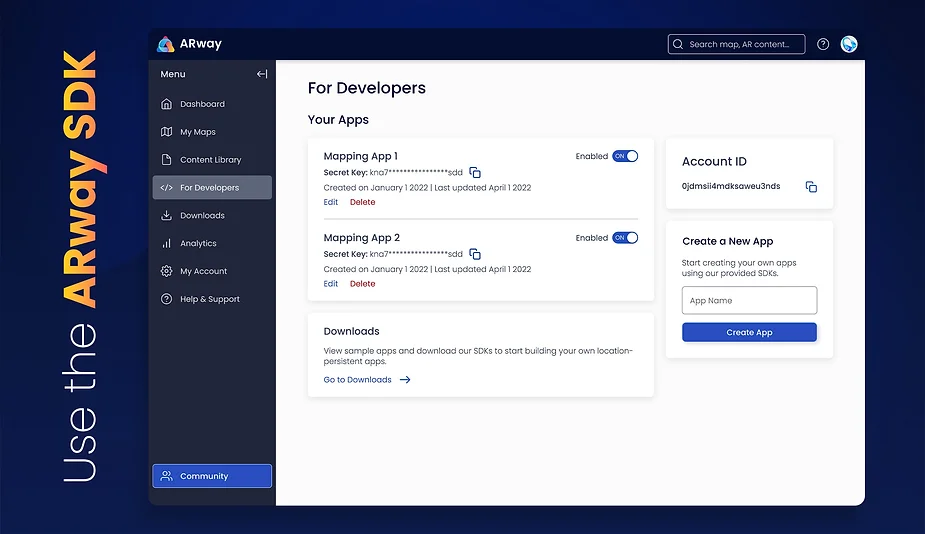
In the field of augmented reality (AR), a software development kit (SDK) is crucial for developing interactive and captivating applications. ARway’s SDK stands out as a comprehensive suite for developers looking to push the boundaries of AR technology. With a focus on user-centric design and advanced technological capabilities, ARway’s SDK simplifies the complexities of AR development, enabling creators to translate visionary ideas into reality.

What sets ARway’s SDK apart is its seamless integration of user-friendly interfaces with high-end AR functionalities. This unique combination ensures that developers, regardless of their expertise level, can efficiently navigate through the intricacies of AR development. From spatial mapping to real-time data analytics, the SDK covers a broad spectrum of features that are pivotal in today’s AR landscape. Moreover, ARway’s commitment to continuous innovation means that the SDK is regularly updated, keeping pace with the ever-evolving demands of the AR domain.

This article dives into the myriad of features offered by ARway’s SDK, highlighting how it’s shaping the future of AR development.

ARway SDK: Powering the Next Generation of AR Apps

ARway’s SDK is a testament to the company’s commitment to innovation. It offers a range of features that are essential for the modern AR developer, from spatial mapping to real-time analytics. Here’s what makes ARway’s SDK an indispensable tool:

1. Spatial Mapping and Localization

At the core of ARway’s functionality is its robust spatial mapping capability, which allows developers to anchor AR content in the physical world with pinpoint accuracy. The SDK’s localization features ensure that AR elements remain stable and consistent, regardless of the user’s movement in the space.

2. Cross-Platform Support

With ARway’s SDK, creating cross-platform AR applications is streamlined. Whether it’s for iOS or Android, the SDK ensures that the AR experience is seamless across different devices, maximizing reach and user engagement.

3. No-Code Content Management

ARway acknowledges the importance of ease of use. The SDK includes a no-code content management system (CMS) that simplifies the process of updating and managing AR content, making it accessible even to those with limited coding experience.

4. Real-Time Data Analytics

Understanding user interaction within AR environments is crucial. ARway’s SDK provides developers with real-time analytics, offering insights into user behavior and engagement levels, which can inform iterative design and feature optimization.

5. Customizable AR Elements

The SDK offers an array of customizable AR elements and templates, allowing developers to maintain brand consistency and meet specific design requirements while saving time and resources.

6. Dynamic Content Integration

Developers can integrate dynamic content like video, 3D models, and interactive animations, ensuring that AR applications remain engaging and up to date with the latest content.

Why Choose ARway SDK for Your AR Projects?

Choosing ARway’s SDK for your AR development needs comes with several advantages:

User-Friendly Interface

The SDK is designed with a user-friendly interface, making it accessible for developers of all skill levels.

Comprehensive Documentation and Support

ARway provides extensive documentation and support, ensuring that developers have all the resources they need to troubleshoot issues and expand their knowledge.

Community and Collaboration

By choosing ARway’s SDK, developers become part of a growing community, fostering collaboration and sharing best practices within the AR development ecosystem.

Why Choose ARway SDK for Your AR Projects

How ARway SDK Enhances Developer Creativity and Productivity

ARway’s SDK not only provides the technical foundation for AR development but also enhances developer creativity and productivity by offering:

Efficient Workflow

The SDK streamlines the AR development process, allowing for quick prototyping and deployment.

Scalability

As projects grow, the SDK scales to meet the increased demands without sacrificing performance or quality.

Innovative Features

With features like image recognition and object tracking, developers can create sophisticated AR experiences that were previously challenging to achieve.

Unlocking AR Innovation with ARway’s Comprehensive SDK Tools

ARway’s SDK is a powerful ally for developers venturing into the world of AR. It combines a user-friendly approach with advanced features, enabling the creation of innovative and impactful AR applications. By leveraging ARway’s SDK, developers can lead the charge in the AR revolution, crafting experiences that captivate and inspire.

For a more comprehensive overview of our advanced developer tools, check our complete tutorial guide below.

About ARway.ai by Nextech3D.ai

Augmented Reality Experience Platform, ARway.ai is a powerful, no-code spatial computing platform that melds the real and the virtual into a single seamless experience. One of its powerful features includes navigation and wayfinding that facilitates the creation of robust AR navigation with accurate positioning, digital directory, turn-by-turn, and optimized routes. To learn more, contact us here.

The customer’s shopping experience heavily influences purchase decisions. A customer with a pleasant experience at your store is more likely to develop a positive association with shopping there and more likely to revisit. Navigating the store, however, can be challenging, especially in larger spaces with multiple aisles or departments. Mall navigation to find the store you’re looking for can also be a confusing and stressful experience for visitors.

Instore navigation is a system that helps customers find their way from point A to point B with specific directions. It makes finding the product they’re looking for, the exit door, the cash counter, or the trial room – an effortless experience by indicating the way so the customer is self-reliant.

Traditional methods of instore navigation have been – following physical signs, getting directions from kiosks, or asking representatives for assistance with directions.

With the popularity of smartphones, instore navigation is available at your fingertips – with apps holding extensively detailed maps.

ARway.ai is a web-based platform that utilizes cutting-edge AR technology to create an immersive experience for indoor navigation. Introducing augmented reality in retail with instore mapping technology has changed how customers navigate and shop.

The Common Hassles in Traditional Instore Navigation

Shopping malls, supermarkets, and large department stores tend to have massive and often complicated layouts that can be very overwhelming for customers. Due to signal obstructions, GPS proves ineffective in wayfinding indoors. Customers relying on physical signs and guidance from store personnel face some avoidable challenges. Let’s understand these from their perspective and uncover the problems associated with traditional instore navigation.

Subpar Customer Experience

The process of finding what you’re looking for is not direct. The customer first has to figure out where to look for directions, after searching for help with directions, then navigate to the destination they are looking for and only then start shopping. This time-consuming journey negatively affects the shopping experience and increases the risk of misreading maps, misunderstanding directions, and getting lost. Compared to smaller stores, the lack of continuous assistance and the additional effort and time spent getting what they need can be physically and mentally taxing.

Unnecessary Distractions

Rather than experiencing what the store offers and exploring different products and brands, customers spend a significant amount of time reading signs and maps to locate the products they are looking for. The complexity of navigation makes it an experience full of distractions.

Time Wastage

Operating wayfinding kiosks, searching for signs, and asking for directions are time-consuming. Even digital smartphone maps take time to be read as they do not pinpoint a customer’s location. Customers often have limited time to shop, and squandering away precious minutes just to navigate within the premises is a wasteful expenditure of time.

Privacy Disruption

According to data from Harvard Business Review, customers like to have more privacy in stores. Customers can be reluctant to approach and ask in-store salespersons for assistance, and the need to do so can adversely affect their shopping experience.

Sales Reduction

According to data from Retail Touchpoints, 67.3% of customers who leave stores empty-handed do so because they cannot find the product they need despite their availability. People find it challenging to locate the products they require despite the availability of signs and maps for navigation, which limits the store’s sales.

Redundant & Tedious Experience

Searching for your destination within the store can be very dull and tedious for customers and people who accompany customers, such as toddlers with their parents. The traditional methods of instore navigation are unengaging and not interesting.

Unnecessary Traffic

With a large number of customers struggling to locate products, a store gets excessively crowded and chaotic. It is only avoided if the customers know the shortest way to their desired destinations at all times without reading complicated maps or numerous signs. Overcrowding is detrimental to a customer’s experience and a store’s sales.

Lack of Safety

Large, maze-like spaces increase the risk of getting lost. Even a brief experience of feeling lost has the potential to jeopardize a customer’s mood to shop and explore the store for products they might be interested in purchasing.

Click here to see some alarming statistics about the biggest problems of shopping at brick-and-mortar stores worldwide.

Simplifying Instore Navigation with ARway.ai

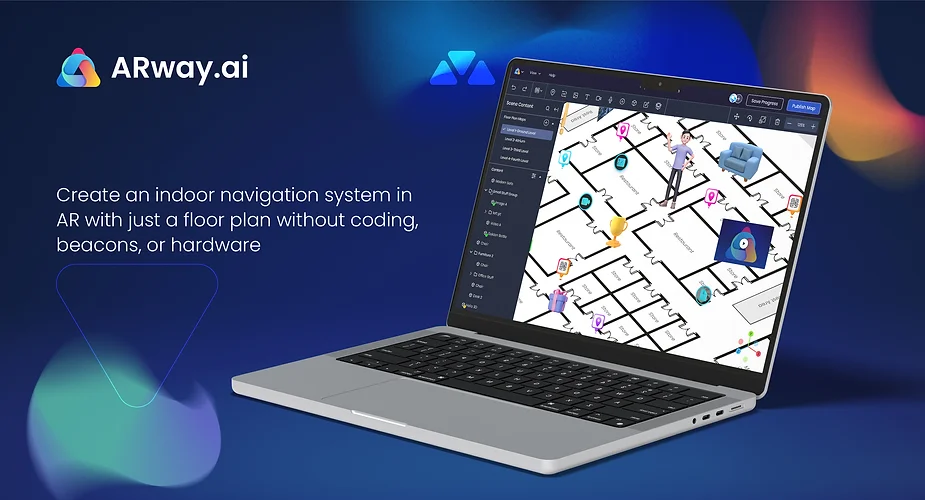
ARway.ai enables you to create an indoor navigation system in augmented reality with just a floor plan without coding, beacons, or hardware. You can create your own store navigation app and white-label it with ARway.ai’s ready-to-use AR templates.

Simplifying Instore Navigation

ARway.ai makes instore navigation easy and reliable, combining blue dot technology with augmented reality, eliminating any possibility of confusion or getting lost. Following directions with clear arrows that change direction as you move or listening to voice instructions is as simple as navigation gets for people of all ages, and it ensures you take the shortest path to your destination.

Watch this video to learn how ARway.ai can transform the retail shopping experience for customers.

It also allows users to add engaging AR experiences along the customer’s route, creating increased monetization and brand awareness opportunities.

Immersive instore experiences along with instore navigation make ARway.ai a real game-changer for retail.

Creating Interactive Retail Experiences with ARway.ai

ARway.ai unleashes a whole new world of endless applications to amplify the shopping experience. ARway.ai allows users to integrate 3D holograms of characters, artists, and brand mascots along with audio for creating captivating experiences.

Arway.ai can be used for creating and sharing entertaining, educational, and promotional experiences.

It allows users to monetize the airspace with AR promotions.

AR announcements and offers are more memorable and impactful than physical mediums like posters or flyers. Users can direct customers to their website, social media, or physical stores with AR promotions.

According to data by Mindshare UK, AR boosts ad recall by 70%. As per data by Threekit, 71% of consumers say they would shop more frequently if they used AR.

ARway.ai empowers you to interact with your customers in a way like never before. You can launch store-wide scavenger hunts fueled with AR characters, interesting audio-visual clues, and surprising experiences in augmented reality around every corner.

Engage your customers with interactive loyalty programs where customers engage with products in AR while physically standing in the store. ARway.ai allows you to trigger entire AR experiences using brand logos and packaging as scannable visual markers.

With ARway.ai, you can transform a simple walk through the store into an interactive experience that customers will talk about long after they leave.

The Benefits of Using ARway.ai for Instore Navigation and Interactive Retail Experiences

ARway.ai unlocks exciting possibilities of augmented reality in retail. Let’s consider some of its benefits.

1. Unbox and Deploy

Go to market with your maps in minutes by uploading your floor plan and launching out-of-the-box, ready-to-use AR templates. No coding is required to create your store navigation map or launch an AR experience.

2. High Accessibility

Users must simply log into the web-based studio to create AR site maps. Customers access these maps by scanning a QR code with their smartphone cameras.

3. Inclusive Experiences

ARway.ai enables users to add voice instructions for customers throughout their journey in the store, making it possible for people with disabilities like visual impairments to make the most of the navigation platform.

4. Guided Tours, Virtual Tour Guides, and Instore Experiences

Multiple visual and audio-narrated guided tours and interactive AR experiences can be easily curated within a single site map. Such tours strengthen the customers’ emotional bond with the brands they encounter and help them engage with more brands on their journey.

ARway.ai users can even add holographic tour guides to the virtual site map to make navigation more captivating and more accessible to follow. This eliminates the need for customers to compromise their privacy by approaching salespersons for assistance.

5. No Hardware or Beacons Required

ARway.ai doesn’t require the installation of hardware components such as BLE beacons. A computer/laptop is all a user needs to utilize the platform’s features. A customer needs only a smartphone to benefit from every facet of the AR navigation platform.

6. Airspace Monetization Opportunities

ARway.ai allows users to monetize the space with tappable ads and brand marketing content in their stores and create additional revenue streams in augmented reality. It makes it exceptionally easy to execute AR-based digital campaigns, including those enhanced with realistic 3D animations.

7. New Opportunities for Gamification

ARway.ai generates the possibility of adding highly immersive and location-persistent virtual games within the instore navigation experience. For example, users can utilize the inbuilt library of AR spatials to design a treasure hunt in augmented reality that allows customers to find hidden virtual ‘treasures’ in the store and redeem points to win rewards.

8. Easy Updating

An interactive store map created with ARway.ai isn’t set in stone. It can be updated as many times and as frequently as users need. You don’t have to create new projects and start from scratch every time the interiors of the store and the placements of products are changed.

9. Cost-Efficiency

ARway’s AR-based navigation platform is significantly less expensive than WPS navigation systems. It is exceptionally cost-effective and accurate at location positioning within an indoor space with multiple stories, including those underground.

10. Vast Inbuilt Library of 3D Models

Static and animated 3D models, called AR spatials, can be added to the AR navigation platform from ARway.ai’s built-in library. It has a wide range of commonly used AR spatials, like moving 3D arrows. It saves users time creating 3D models or finding and importing AR templates from online sources.

11. Creation Studio for 3D Modeling

Suppose a user requires a unique 3D model or AR spatial that isn’t available in the inbuilt library. In that case, they can create it easily in ARway.ai’s Creation Studio and integrate it into their navigation platform.

12. Analytics and Insights

Users can collect insightful data about customer traffic patterns from ARway.ai, including the most frequently visited locations in the store and heat maps of the customer dwell times at various locations in the store. Access to such helpful data enables users to promote ads at prime locations to maximize visibility and conversions.

Click here for an in-depth understanding of ARway.ai and its instore navigation features.

Click here to connect with us if you have queries about instore mapping.

As far as the realm of technological innovation is concerned, location-based augmented reality (AR) stands as a fascinating frontier, seamlessly merging the digital and physical worlds. At its core, geo-based augmented reality refers to integrating virtual content into real-world environments, forging a dynamic connection between the digital and tangible realms. In this blog, we will explore the potential of this technology, especially in different industry domains.

Understanding Location-Based Augmented Reality and How It Works

Simply put, location-based augmented reality integrates digital information with the physical world based on the user’s location. This means it overlays virtual content such as graphics, data, or animations onto the real environment and provides context-specific information and experiences to users.

Location-based AR apps leverage GPS, sensors, real-time location systems, and mapping data to pinpoint a user’s position. It accesses the device’s GPS coordinates, compass direction, camera, and additional sensors like accelerometers to determine the user’s orientation and location. Next, AR software connects this data with the relevant points of interest (POI) and overlays virtual content onto the real-world environment.

As a result, this technology provides real-time information to users and creates an interactive and immersive experience for them. Its benefits include improved engagement, personalized experiences, enhanced navigation, and enriched learning opportunities. It boosts operational efficiencies and transforms various industries by merging the digital and physical worlds.

The Impact of Geolocation AR on User Engagement

Geolocation AR significantly boosts user engagement by providing personalized, context-aware experiences. The personalization options and location-specific nature of content delivery enhance user engagement by creating more meaningful interactions between individuals and their surroundings. This dynamic approach brings several benefits, such as increased customer loyalty, amplified brand recognition, and a heightened sense of environmental connection. Users become active participants in a digitally augmented world, where each step holds the potential for discovery.

Location-Based AR: Transforming Diverse Industries

The versatility of location-based AR finds applications across various industries, revolutionizing how we perceive and interact with information. For example, businesses can run targeted promotions in the marketing and advertising industry based on the user’s physical location. Construction and real estate benefit from visualizing architectural plans overlaid onto physical spaces, facilitating better decision-making.

The gaming industry witnessed an astounding shift with the advent of location-based AR games like Pokémon GO. This fusion of gameplay and real-world exploration captivated users worldwide, setting a precedent for interactive entertainment. The tourism industry embraces this technology to offer immersive guides and virtual tours, while the retail sector taps into location-based promotions and personalized shopping experiences.

Even the event management industry leaps forward, with augmented reality applications enhancing the attendee experience with interactive maps, boosting participation, fostering networking, and transforming venues into dynamic spaces. This technology undoubtedly signifies a transformative era, redefining conventional practices across diverse industries!

For further reading, please see What is Digital Wayfinding: Top 10 Benefits.

How ARway.ai is Leveraging Location-Based AR Technology For Users

Augmented Reality Experience Platform, ARway.ai is a powerful, no-code spatial computing platform that melds the real and the virtual into a single seamless experience. Here’s what ARway offers –

Intelligent AR Navigation

Bid farewell to traditional static maps and signages and make indoor navigation a more interactive, informative, and user-friendly experience. Equip users with a real-time, heads-up display that seamlessly integrates sensor data and AR overlays, offering valuable information and guidance within the physical environment. Employ intelligent indoor positioning solutions to provide dynamic and personalized directions to users, creating an immersive and intuitive AR experience.

Directory of Points of Interest (POIs)

Enhance indoor navigation and accessibility with designated POIs within your map and help users locate key attractions quickly and effortlessly. Be it shopping malls, airports, or hospitals, a directory of POIs will empower visitors to navigate to these locations independently by following waypoints and directional arrows. In addition to that, collect valuable data on user behavior by collecting data on their movements and interactions. Thereafter, analyze this data to make strategic decisions regarding map layout and content and promotions placement.

Step-by-Step Directions

Simplify navigation within complex indoor spaces and help users reach their destinations efficiently. Step-by-step directions are updated real-time, providing the most accurate routes, saving time and significantly minimizing confusion for visitors. Implement this advanced indoor wayfinding technology to improve accessibility and foster inclusivity for all users, including those with disabilities.

Optimized Routes

Leverage advanced mapping and positioning technologies to share the most efficient path with users. Using real-time data, determine factors like distance, congestion, obstacles, and accessibility to provide users with the most direct and convenient route to their desired destination. Further boost visitor confidence by sharing detailed indoor wayfinding information, such as step count, distance, and estimated arrival time. All in all, create a smooth and positive user experience.

Key Features of ARway:

1. No Coding Skills Required

Create interactive and engaging AR experiences without writing a single line of code.

2. Instant Map Activation

Create a map and upload a floor plan, place a QR code on the location, scan it to anchor the map, align the floorplan, drop pins at POIs, and then drag and drop AR content to publish the map. Activate your map within hours, not days!

3. Reduced Costs

No hardware means no expenditure on the installation, configuration, or maintenance of beacons. Get started with a cost-effective and hassle-free indoor navigation system.

Why wait? To learn more about this advanced AR navigation solution, contact us here right away!

Conclusion

As we navigate this evolving landscape of technology, the power of location-based AR becomes increasingly evident. The ability to blend virtual elements with our physical surroundings opens new doors of opportunity across diverse industries. Embracing this technology is not just a technological leap; it’s a step into a more immersive, interconnected, and engaging reality.

When it comes to conferences and trade shows, ARway has a proven track record of making these complex spaces and events easier to understand and navigate. But augmented reality navigation – as powerful as it is – is just the tip of the iceberg. ARway transforms trade shows for sponsors, exhibitors, and attendees through new opportunities, inventory, and experiences. In this post, we’ll explore these topics and will provide real-world examples of these various approaches in action.

For Sponsors

Let’s start by radically reimagining the physical space associated with these types of events. At approximately 5.3M square feet, the Messegelände Hannover in Germany is currently the world’s largest exhibition facility. As large as spaces like this may be, they are still constrained by physical limits and dimensions. Forget square footage or even cubic footage when it comes to trade shows. Now, the sky’s the limit. And if you need to go beyond the sky, that’s OK too, since augmented reality (AR) makes any space as boundless as the imagination.

The space above and around the physical can become a canvas for massive and engaging augmented reality opportunities. Show floor airspace offers new value for event management, sponsors, and exhibitors. AR advertising and marketing can exist everywhere and nowhere at once.

In 2022, Chipotle created an amazing AR experience in partnership with the NHL’s Colorado Avalanche. In it, an enormous food container was pushed onto the ice. Suddenly, the ice began to crack, and a hand gloved in the Avalanche’s iconic colors reached through the ice to grab the bowl. As they say in show biz, the crowd went wild!

Augmented reality made it possible for the ice – and imagined space beneath the ice – to come alive in ways that would be impossible without the power of AR. For sponsors, all of this means more potential inventory, more potential engagement, and – in the end – more potential revenue!

For Exhibitors

Let’s face it, the typical trade show booth can be a pretty boring affair. Sure, you can dress them up and add bells and whistles, but you’re limited by the laws of space and time. Breaking the laws of science is fun and easy using AR, and the results can be jaw-dropping. For exhibitors, making the experience as memorable as possible is the name of the game, and AR delivers.

It’s out with the old and in with the bold when you can do away with dull product demos and tired paper brochures and banners. They can be replaced with AR experiences that can put rich, contextual information in front of your audience. It’s also what attendees say they want. According to one recent survey, 84% of respondents reported feeling more engaged and spending more time with exhibits that implement AR.

At Restaurants Canada, ARway made it possible for holograms and people to come together in stunning and novel ways.

This lesson can be applied to any piece of marketing collateral and is just one simple example of how AR can improve the user experience.

For Attendees

Who doesn’t love a good trade show? That first day, seeing old contacts and colleagues, checking out prospects and competitors, and seeing the latest and greatest laid out before you – what fun. By the second day, things may start to lose their luster, and by day three? By day three, you are overwhelmed, worn out, and counting the minutes until you can leave. It doesn’t have to be that way – and AR is the key.

AR makes it possible to show, not just tell, attendees about a product or service. Not just with video or even an in-person demo but through an immersive AR simulation that allows attendees to explore and become immersed in the trade show experience. People have come to expect and value hybrid experiences that seamlessly combine the real and the virtual.

ARway made it possible for attendees at one trade show to pop a pizza into their phone as part of a scavenger hunt that made the entire show floor one gigantic game space!

As event attendees get younger and younger, they’ve made it clear they’re looking for more interactive and tactile experiences. AR allows you to deliver on these expectations – and beyond – to provide more meaningful and memorable events.

Robust Yet So Simple

You may be thinking that all of this sounds marvelous, but there must be a catch. That is something you’d need a Ph.D. in computer science to figure out. With ARway, that is certainly not the case. ARway provides a powerful no-code spatial computing platform that allows for the creation of robust AR wayfinding experiences populated with real-time navigation, guided tours, detailed 3D objects, trigger-based activations, and other rich media content.

Creating an experience can be as simple as generating a QR code in the app, placing the QR code in the venue, scanning it with a smartphone camera, and then creating the experience in the web studio with assets from the ARway Creator Portal – no coding required. ARway works without expensive and finicky hardware like beacons, sensors, or tags. A new experience is almost just a few swipes away. But simplicity doesn’t come at the expense of power or capabilities. Not only can ARway help create these experiences, but it also allows you to measure their impact to understand and improve how booths, trade show floors, and the massive venues that house them can be better used and improved upon.

Navigation may be the first step, but AR can be used to do so much more. If you want to stand out at upcoming trade shows and events, ARway can help with amazing 3D/AR elements that will turn heads. Reach out to ARway here for more information.

The goal of advertising is to lead people to your products and services. The goal of augmented reality (AR) wayfinding is to lead people to their destinations. Combining the two leads to ARdvertising, the latest – and greatest – new tool for reaching people. ARway has been leading the way with advanced augmented reality tools that revolutionize wayfinding and advertising!

While advertising has existed in one form or another for centuries (millennia even, according to some), it became a practice and profession only in the nineteenth century. Since then, advertising has become the engagement engine for businesses, large and small. Advertising has always been about taking advantage of new media types and channels, new trends, and new technologies. We’re at a fresh inflection point now, where advertising can finally be freed of its biggest challenge: outdated advertising methods that numb consumers to advertising messages.

Ads of the past assumed people were coming to them – in print, on radio and television, online, etc. Publisher content served as a proxy for the audience. Advertisers worked hard to create ads that would fit well with the content and likely to attract customer attention and interest. Over the years, all kinds of tools and technologies have been used to make that happen, everything from the overhyped subliminal advertising in the 1950s to the relentlessly targeted advertising we all face today.

This Space for Rent

One of the biggest and most persistent limitations advertisers have faced has been the amount of space or inventory in which to place ads. In the world of fixed media – print, broadcast, and outdoor – the opportunities were limited. There are only so many 30-second advertisements that can run in a 30-minute program block.

Online advertising seemed to free advertisers of this constraint, and new kinds of advertising appeared. Banners, interstitials, news feeds, and sponsored content all come to mind. These benefited from an unprecedented volume of customer data and an unbelievable ability to micro-target advertising to very narrow audiences.

What Do Consumers Think of Heavy-Handed Advertising?

As promising and powerful as this model has been, it has resulted in a consumer backlash. Concerns over privacy, the creepiness of being followed around websites and apps by advertisers, and sheer “banner fatigue” have made even the plump goose of online advertising stop laying its precious golden eggs.

Now is the time for advertisers to think more creatively to go beyond the spot or banner. The next generation of advertising needs won’t be limited to the page or the screen. The very air around us is the next frontier for creating meaningful brand experiences, and augmented reality will be a key to that future.

Writing for PointIndustria in 2021, Yura Velichko, wrote, “Using AR for advertising is a legit move for marketers who want to create more engaging ads, build an emotional connection with customers, and yield higher conversion rates for businesses.” That is certainly true, and some big advertisers have gotten the memo!

Can Augmented Reality Make Advertising Awesome?

In its 2019 campaign, “Burn this Ad,” which ran in Brazil, Burger King invited customers to “burn” advertising by McDonald’s and other competitors in exchange for a free Whopper through the power of AR. Don’t worry, though, the flames were virtual. People could point their phones at a competitor’s advertisement and watch in amazement as flames “burned” it away to reveal a tasty BK ad in its place! The clever campaign not only generated sales and impressions but also netted the company a coveted Cannes Lions award.

In 2014, Pepsi created awareness for Pepsi Max – and mayhem in London – by installing an incredible AR advertising experience at a bus shelter. Through the magic of augmented reality, robots, monsters, UFOs, and other amazing sights were seen by shocked (and ultimately amused) travellers!

Are There Perfect Placements for Augmented Reality Advertising?

Increasingly, augmented reality is being used to enhance wayfinding and make people’s paths through events, expos, and exhibits a lot smoother than using static maps or apps. AR wayfinding from ARway is finding its way into medical centers, colleges and universities, museums, retail outlets, and more.

As with actual real estate, virtual location is everything. Not only does AR wayfinding improve the navigation experience, but it opens the door to the types of advertising experiences that surprise and delight consumers. The ability to serve location-based AR advertisements has resulted in completely new ways to engage consumers on the go.

When it comes to these next-gen AR advertising capabilities, ARway is leading the way with some amazing activations.

Reinventing the In-Store Experience with AR Activations and Navigation

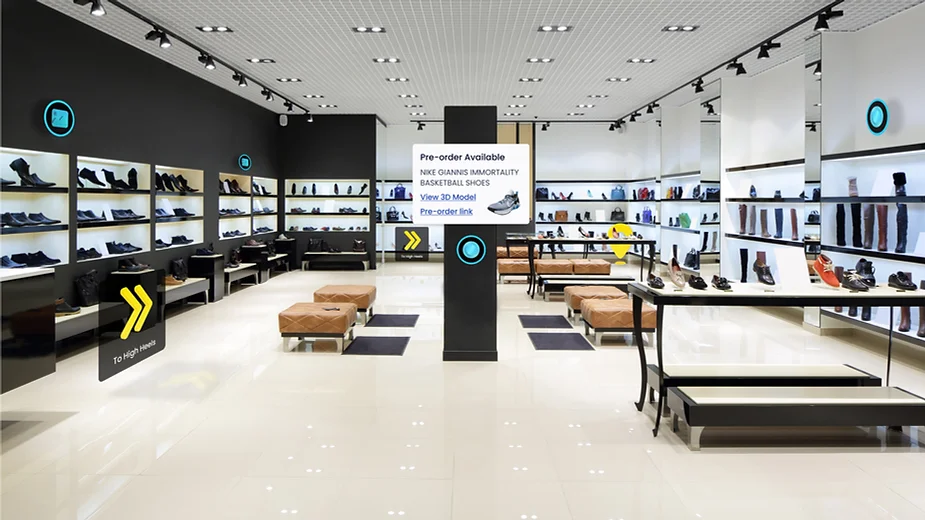
Who wouldn’t want to shop in this ARdvertising-enhanced store of the future?

Augmented reality-powered advertising can improve conversions, create deeper and more meaningful engagement, forge closer relationships with consumers, help drive sales, and expand reach. This last point is particularly important for brands hoping to reach Gen Z-ers, for whom novelty and new experiences are key.

ARway, Leading the Way

ARway makes it simple to create these meaningful and memorable experiences using advanced augmented reality. Your customers simply scan a visual marker or a QR code, and the world around them leaps to life. Not only is their path forward highlighted in a simple-to-follow manner, but advertisements and promotional coupons can swoop in from any direction. This creates a strong and memorable impression on consumers and results in downstream impact for brands!

Whether at a shopping mall, a sports stadium, a trade show, or a transit hub, the combination of AR wayfinding and advertisements can go a long way. Not only to help people find their way but also to help them find their way to your products and services.

If you’re ready to take the next step in advertising (or should we say ARdvertising!) ARway can show you the way. Contact us here for more details and information.

Every construction project, no matter how large or small, begins with the germ of an idea. As the vision is developed and refined, the project moves from the drawing board to the construction site and ultimately to completion. Technology has become critical to the success of any construction project, and our augmented reality wayfinding tool, ARway, is no exception. It gives property owners, investors, designers, engineers, and contractors the power of augmented reality and 3D visualization. With it, these groups can optimize efficiency, improve health and safety, and enhance the experience at every stage of construction.

One can imagine a major construction project as a bell curve. At the start, activity levels are lower and involve smaller groups of people. As the project progresses, activity levels increase dramatically before reaching the final punch lists and the completion of the work.

For a project to be successful, each phase must happen on time and to spec. Once the ideation and design phases are complete, pre-construction begins, and that’s when things really start falling into place. Before that silver-plated commemorative shovel breaks ground, technology has been used to refine and test the design, construction plan, supply chain, and a million other details again and again. ARway plays a valuable role during this important time.

ARway helps architects, engineers, and contractors in two key ways during the pre-construction period:

AR Project Design Visualization

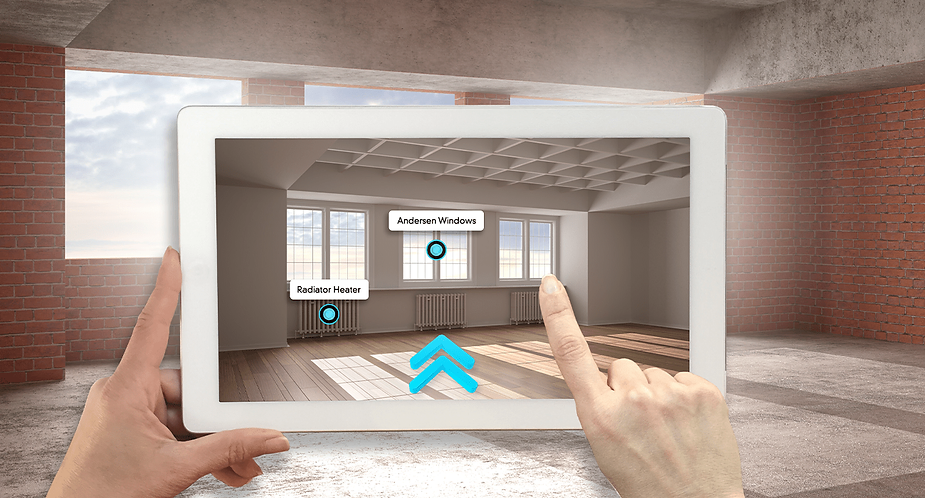
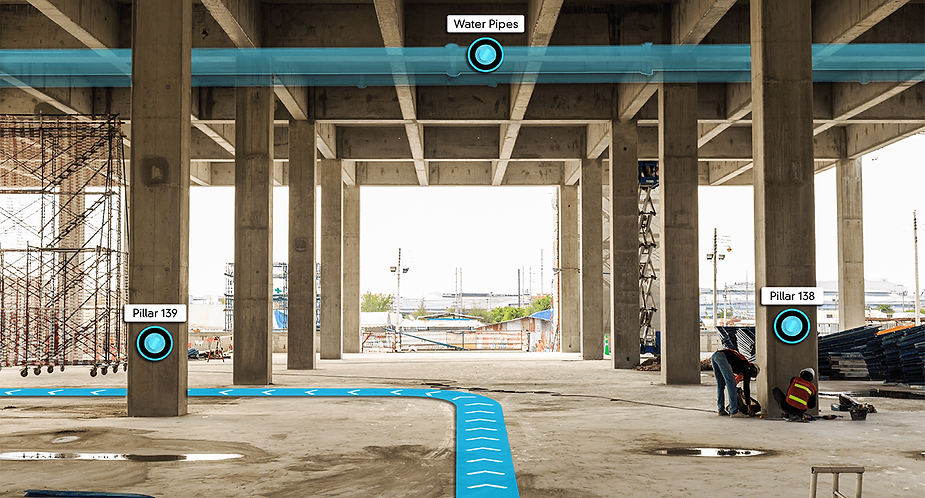
ARway makes it possible to view every aspect of a project at full scale using augmented reality – from the initial design to the (virtually) finished product. Other AR content types – such as hotspots, text, images, videos, and links – can be added to provide more contextual information about the project and enable collaboration and information sharing.

AR Project Design Visualization

AR-powered Onsite Navigation

ARway can deliver a map for visitors and workers alike, making it safe and simple to navigate a construction site at every stage. In the pre-construction phase, in particular, this is critical since many navigational aids will not yet be in place.

AR-powered Onsite Navigation

Together, these features – along with others – offer some important benefits:

Not only can ARway help with the pre-construction phase of a project, but its technology is equally valuable during the construction and post-construction periods. During construction, for example, ARway can be used to understand the impact of design changes or improve collaboration across functional teams. In post-construction, ARway enables AR/VR showings of a property and provides the ability to include navigational content or advertising in virtual spaces.

ARway provides powerful new capabilities for the real estate industry – from design to groundbreaking to ribbon-cutting and beyond. If you are facing an important construction project and would like to learn more about how ARway can help, contact us here.