Arway Logo

exclusive webinar

Live Button

Explore ARway.ai’s Advanced Capabilities:

Navigating New Augmented Reality Experiences

Online • Wed April 24, 2024 • 9AM EST • 3PM CEST

There are so many exciting applications for spatial computing and augmented reality-powered wayfinding. These technologies are revolutionizing one industry after another, everything from stadiums to museums to events to retail – and more. What all of these have in common is the fact that they are large spaces where people really benefit from the navigation and contextual information provided by ARway.

Another industry that benefits from this technology is commercial real estate, and we’re going to drill down into this one in this post. But before we do, it makes sense to define spatial computing and wayfinding.

Spatial computing brings together virtual reality (VR), augmented reality (AR), and mixed reality (MR) to enhance people’s experience of the real world. Spatial computing makes it possible to move through and interact with the digital and the physical world simultaneously. It’s an amazing technology that opens the door to new opportunities and experiences.

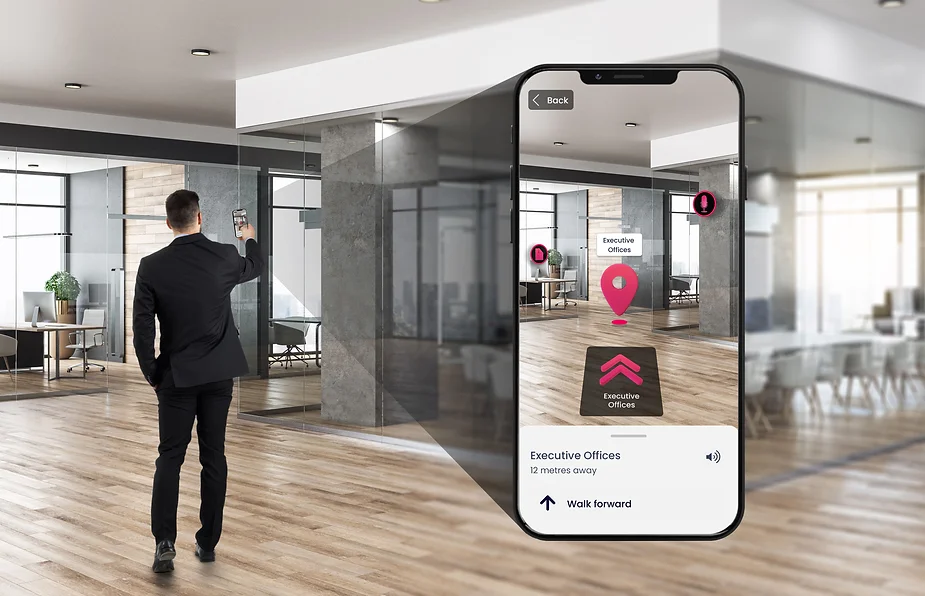
Wayfinding is one of the primary uses for spatial computing, and it is especially relevant for the commercial real estate market. People struggle with orienting themselves to a new space using a static 2D map. Wayfinding brings digital navigation into the real world, making it easy to present a space in an engaging and meaningful way.

wayfinding

For commercial real estate, these technologies literally put the power to explore a property into the hands (or cell phones) of prospective tenants and buyers. Spatial computing and AR wayfinding are broad terms, so let’s explore a few more specific examples of how these technologies can enhance the commercial real estate experience.

Augmented Real Estate Showings

Agent-free showings allow potential buyers and tenants to tour a property independently. ARway’s accurate turn-by-turn navigation routes with customized wayfinding pathways gives more freedom and flexibility to buyers and tenants – and frees up time for agents. ARway allows you to put your property’s best face forward and ensure prospective buyers or tenants will find themselves exactly where they need to be.

Property Details

To help buyers visualize a property and its amenities, ARway can show every aspect of a space in detail with AR annotations. People can simply tap on the annotation to see additional selling points about a particular object.

Augmented Staging

ARway can bring your property to life by appending interactive content to objects and areas in your space. This is a great way to give potential buyers and tenants the ability to envision how they might use a space. Whether it’s testing furniture layouts or experimenting with lighting fixtures, AR tools help facilitate critical design.

Advertising and Marketing in the Airspace

In a highly saturated, competitive market, brokerage agencies can use AR technology to advertise themselves in the property airspace with augmented brochures and banners.

These are just a few examples of how spatial computing and AR-powered wayfinding can benefit the post-construction commercial real estate market. The applications for engineers, architects, contractors and property owners in the pre-construction and construction stages are just as innovative. It’s a challenging time to be in the commercial real estate market, but ARway can give you a competitive edge.

This post only scratches the surface when it comes to the impact of ARway on the commercial real estate industry. In future posts, we’ll share more details on how ARway and AR wayfinding can benefit engineers, contractors, and architects in the pre-construction phase and beyond.

If you are ready to bring your properties to life in a powerful and engaging way, the time is right for ARway. Contact us here to learn how spatial computing can make a big difference for you.

Helping patients, visitors, and hospital staff navigate hospitals with ease using augmented reality (AR) wayfinding

Augmented Reality Wayfinding for Hospitals

Hospital with a guided tour, location pin, and AR activations.

Hospitals are designed to serve a diverse set of patients and needs, meaning there are a lot of route options for visitors to take. As a large-scale environment with complex transit and navigational systems, it’s no surprise that 30% of first-time visitors get confused and lost in hospitals.

This issue isn’t anything new, and it must be addressed as it risks a lower patient experience score and distracted staff directing visitors. By implementing technologies like augmented reality (AR), visitors and other parties alike can navigate hospital grounds with ease.

Continue reading below to discover the benefits of AR wayfinding for hospitals.

Improve the Patient Experience by Reducing Stress and Agitation

Hospitals are stressful for both patients and family members. Whether it’s a long stay or a brief appointment visit, it’s an uncomfortable and vulnerable environment. By assisting visitors to get where they need to be without one wrong turn, stress is kept to a minimum.

ARway app - following a guided tour populated with AR activations.

ARway app – following a guided tour populated with AR activations.

A properly executed wayfinding system powered by AR ensures that users always know exactly where they need to go and how to get there, helping them to stay calm. An interactive, 3D map is a major improvement against an approximate 2D layout of a building. It reduces anxiety by allowing patients, visitors, and staff to choose any point in the map directory and follow an intuitive AR navigation path with step-by-step instructions to reach their destination. All they need is a cell phone with a camera. It’s immersive and reduces anxiety by allowing visitors to choose any point on the map for accurate directions. This easy to follow navigation can be accessed via a smartphone app where the wayfinding system will then overlay arrows onto the visitor’s camera display.

By empowering visitors to navigate around hospital facilities independently, staff are less likely to be distracted and asked for assistance. Studies have shown that if visitors do not have direction – or reassurance of their direction – every 30 feet while traveling through a facility, they will likely stop and ask an employee for directions. This leads to an astounding 40% of visitors and patients depending on hospital staff for wayfinding assistance. And although hospital staff are there to help patients, those few minutes providing directions add up quickly and make all the difference in an industry where minutes can mean a life saved. Interactive guides and preset evacuation routes are additional time savers, as staff won’t be relied on to decrease or redirect the flow of traffic to specific areas of the hospital during emergencies.

By keeping patient stress to a minimum and being on time, hospitals can expect happier customers and a decreased workload for their staff. Sticking to schedule leads hospitals to then reduce the costly impact of late and missed appointments, which cost hospitals an overwhelming $150 billion annually in the U.S.

Improve Spatial Awareness and Safety for Patients, Hospital Visitors and New Staff

An interactive wayfinding map can have even more incredible value added to it. Hospitals have the ability to insert contextually relevant information as visitors and staff move about. If new staff or a visitor needs to get to a specific wing, names can be displayed in AR as well as those of rooms and points of interest to inform and better guide them.

Hospital hallway with AR activations and location pin navigation.

Hospital hallway with AR activations and location pin navigation.

In addition to preset evacuation routes, hospitals can provide instant notifications to safely guide patients to their destination from arrival to departure by displaying the latest policy and guides instantly on their screen in AR, eliminating wasted time searching for the most up-to-date hospital routes or rules and the possibility of a missed appointment.

These notifications can also extend to reminders, providing on-the-go health and safety reminders to visitors, patients, and staff, such as hand-washing procedures.

Lastly, gamifying the hospital experience with AR can be particularly helpful for distracting kids and reducing anxiety in places like waiting rooms. Gamification can range from AR object collection games (think Pokemon Go!) to interactive learning, such as science fun fact AR cards.

Enhanced, Simpler Hospital Facility Management

With more visitors using the wayfinding app, these data insights can be collected and leveraged to improve the overall hospital experience, operations, and safety. By understanding how hospital visitors occupy spaces, their most used routes, where they spend the most, and where they often get lost, facility managers can make meaningful improvements to the campus layout and improve navigational instructions as well as optimize energy use while even reducing operational costs.

Ready to create a patient-centric hospital experience? Visit ARway.ai to learn how to get started.

Maps have long been sources of fascination for people. In a recent post, we explored a broad range of map-making technologies, including LiDAR, a critical component of the ARway platform. In this post, we are going to scroll back a bit to understand how we got here and to consider the history and evolution of maps as objects and tools. We’ll also delve into how new technologies have allowed deeper levels of engagement, especially for mapping complex indoor spaces to improve the overall experience.

A two-dimensional representation of three-dimensional space has been a challenge since the dawn of time. The very earliest map, the Bronze Age Saint-Belec Slab (mentioned in the LiDAR post), was actually three-dimensional itself. This map – like other ancient and pre-modern ones – was not intended for navigation, but instead was to represent a space symbolically. In the case of the Saint-Belec Slab, scientists recently determined that it represents an area along the River Odet in Brittany. Amazing, yes, but at 5’ by 6.5’, not exactly portable!

Let’s look at a few of the other major milestones in the history of maps:

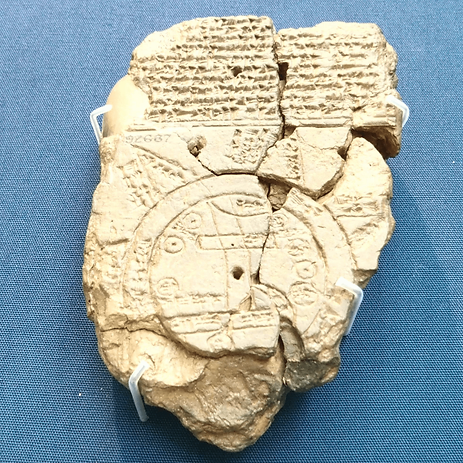
Mesopotamia, 700-500 BCE – a clay tablet showing Babylon at the center of the world. More detailed than the Slab, but still not a navigational tool. It served more to understand the relationship between spaces and to orient users as to their place in the world.

The Babylonian map of the world. Late Babylonian, 700—500 BC.

The Babylonian map of the world. Late Babylonian, 700—500 BC.

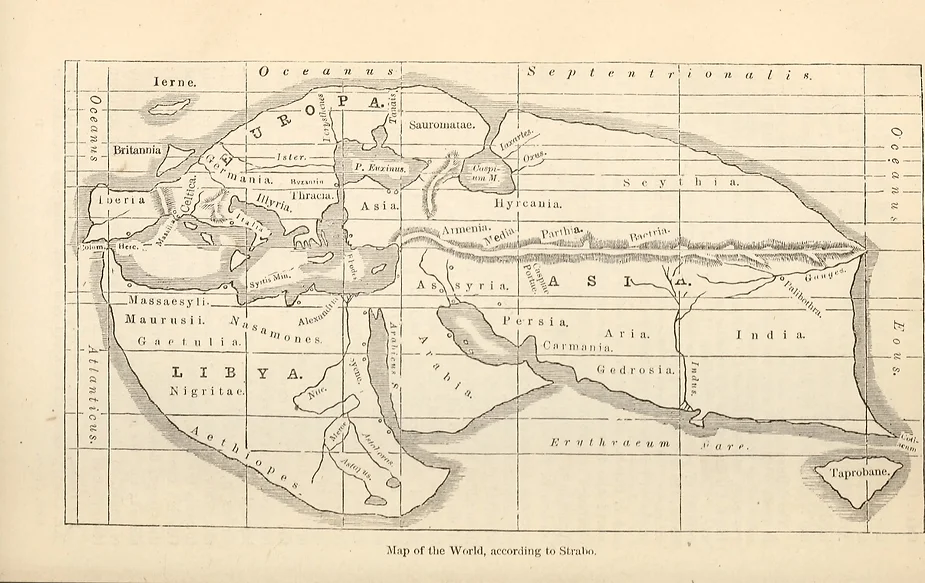
The Roman Empire was an administrative marvel, and its maps, like the famed Strabo one, attempted to present an accurate depiction of the world as it was then understood at the time. Helpful for running an empire, perhaps, but not so good at getting around one!

Map of the world, according to Strabo

Map of the world, according to Strabo

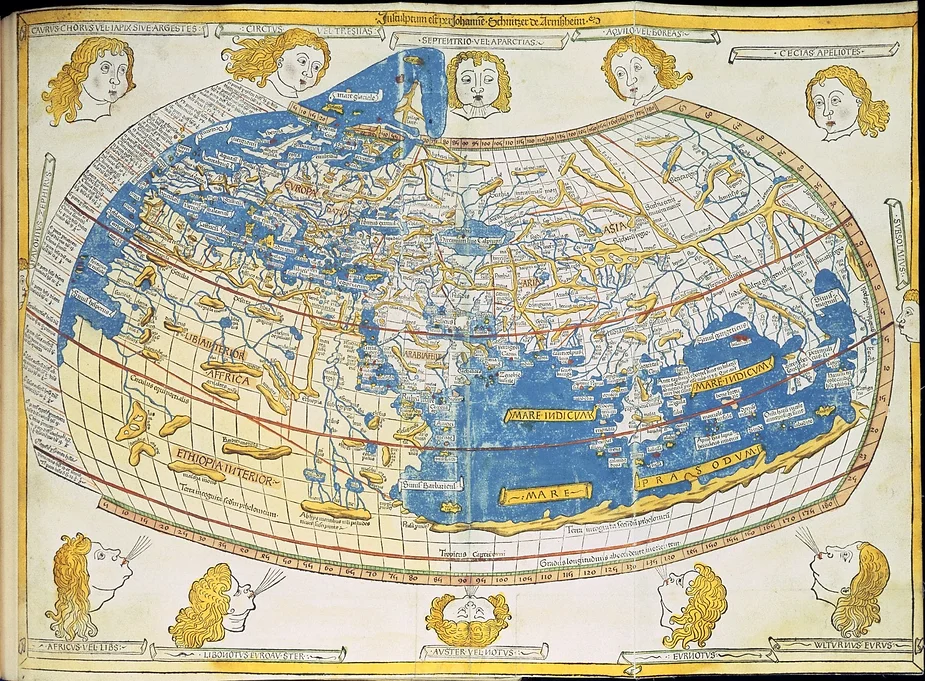
Alexandria, Egypt, 100 CE – Ptolemy created the first map that correctly placed locations in (approximate) relation to each other. He accomplished this through the creation of longitude and latitude, which allows every point on the globe to be accurately described using the two sets of coordinates. Think of it as early geolocation technology!

A 15th-century version of Ptolemy’s map.

A 15th-century version of Ptolemy’s map.

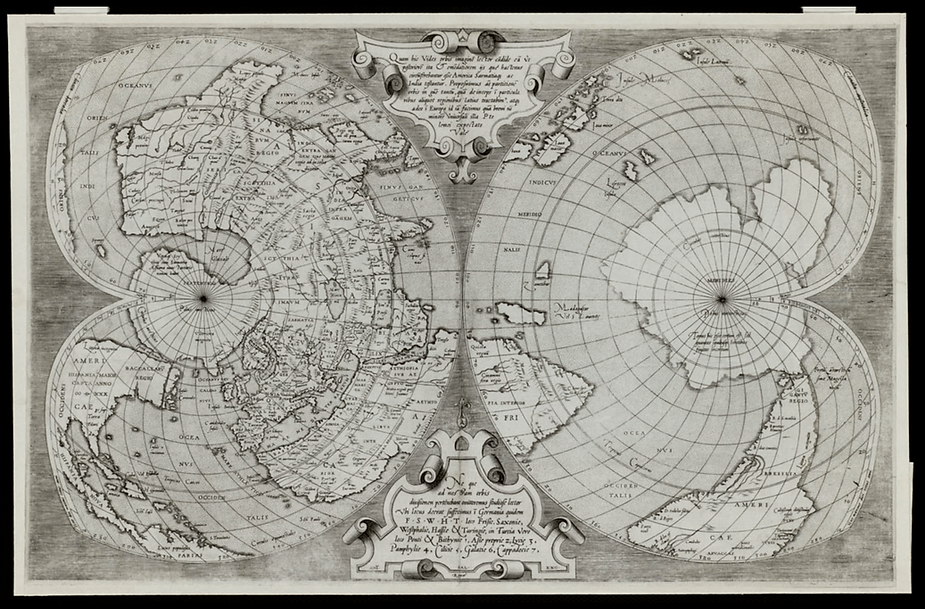
Flanders, 1538 – After Ptolemy’s invention of latitude and longitude, Gerardus Mercator’s eponymous “projections” were the next big thing in mapping. Mercator’s insight allowed a flat map to represent the geometry of a round world.

A 1550 engraving based on Mercator’s work.

A 1550 engraving based on Mercator’s work.

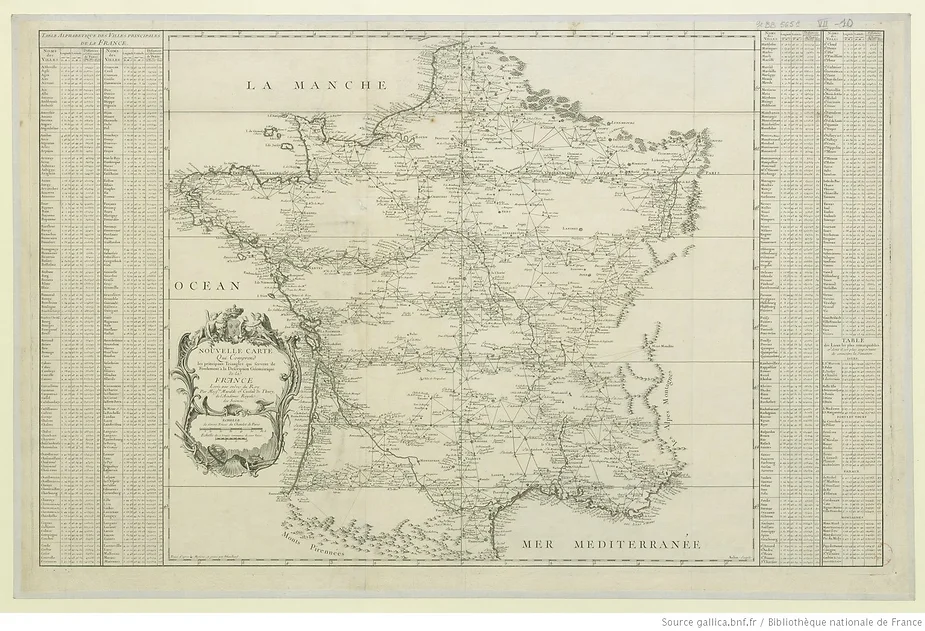
Paris, 1744 – To further increase the accuracy of maps, the Cassini family were the first to use geodesic triangulation to create a precise representation of space – in this case, France. Hey, is that an outdoor cafe I see there?

Cassini’s 1744 map of France.

Cassini’s 1744 map of France.

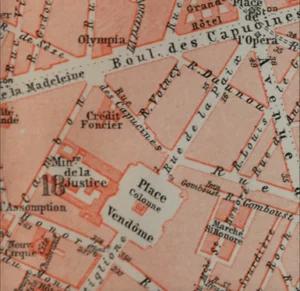
Koblenz, 1832 – While guidebooks had been popular for many years by the early 19th Century, Karl Baedeker improved the model by providing content and context that would be interesting and helpful for people using his firm’s guides. One could say this was the birth of today’s digital points of interest (POI) technology!

At each step along the way, maps carried more and more detail and information. This progression was carried to the point of absurdity by Argentine author Jorge Luis Borges. His collection of stories, The Maker, first published in 1960 includes a short excerpt, purportedly from a larger imaginary work, titled “On Exactitude in Science.” It describes a “cartographers guild” that created a map as large and detailed as the space it seeks to present – even when that space is as large as an empire. The result is a meta-map, if you will, combining the real and the imagined in one space.

Detail from page 674 of "Paris and environs, with routes from London to Paris. (1913)

Detail from page 674 of “Paris and environs, with routes from London to Paris. (1913)

Spatial Computing for Navigation

Perhaps it’s not so absurd after all. In some ways, this is what we do with ARway, our real-world Metaverse spatial mapping platform. We apply proven – and emerging – spatial computing technologies to enable advanced wayfinding and navigation capabilities. These allow ARway customers to enhance real-world locations at scale with interactive content, customized routing, audio, images, holograms, and more. For map users, the experience is like peering through a magic window, where the world can still be seen but where it has been enriched in new and wonderful ways.

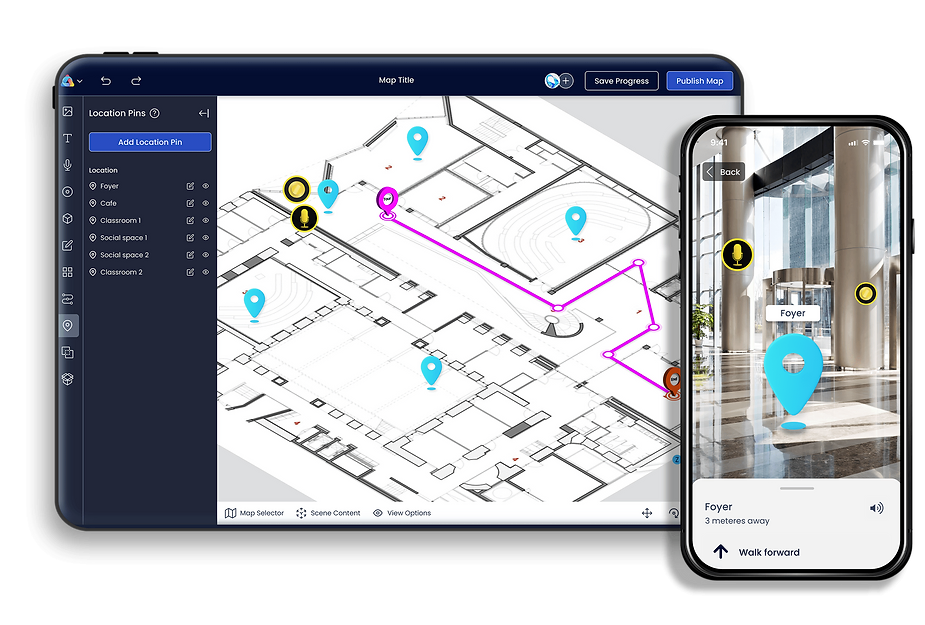
To the left: ARway creator portal with an AR-populated floorplan. To the right: ARway app showcasing the map in use.

To the left: ARway creator portal with an AR-populated floorplan. To the right: ARway app showcasing the map in use.

The applications for this technology – like the utility of maps themselves – are boundless. From wayfinding and navigation to augmenting advertising with contextual information that helps shoppers find exactly what they are looking for, ARway melds the real with the virtual and connects both to place. If you’re interested in stepping into the visionary maps of today, contact us here.

Attribution

¹ “The Babylonian map of the world Late Babylonian, 700—500 BC” by Haluk Ermis is
used under CC BY 2.0.

² “Map of the World, according to Strabo” is in the public domain.

³ “Beatissimo Patri Paulo Secundo Pontifici Maximo. Donis Nicolaus Germanus” a 15th
century version of Ptolemy’s map is in the public domain.

⁴ “Quam hic vides orbis imagine[m] lector ca[n]dide ea[m] ut posteriore[m] ita & eme[n]datiorem ijs que[…]” a 1550 engraving based on Mercator’s work. The image is used under CC BY 2.0.

⁵ “Nouvelle carte qui comprend les principaux triangles qui servent de fondement à la Description géométrique de la France. Levée par ordre du Roy par Messrs. Maraldi et Cassini de Thury, de l’Académie royale des Sciences. / Tracé d’après les mesures et gravé par Dheulland ; Aubin scripsi” Cassini’s 1744 map of France. In the public domain.

Detail from page 674 of “Paris and environs, with routes from London to Paris : handbook for travellers” showing not only streets, but also places of interest. In the public domain.

Augmented Reality-powered indoor navigation and location-based marketing elevate exhibitor booths and improve visitors’ experience.

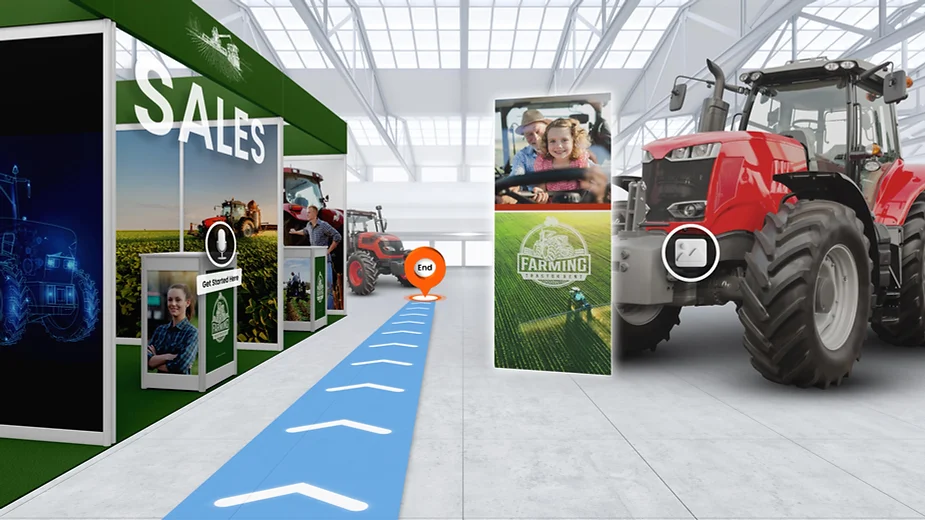
Tradeshow floor with a guided tour and spatial activations.

Tradeshow floor with a guided tour and spatial activations.

Tradeshows are becoming increasingly popular once again, as like-minded people with similar interests are surrounded by plenty of booths, and thus, plenty of opportunities. But how can a business stand out from the crowd and attract as much attention as possible?

Basic videos or typical handouts aren’t enough when your competitors are garnering for that same attention. That’s why ARway is here to help businesses implement 3D and AR interactive elements to futurize the tradeshow experience. It enables businesses to connect with visitors on a more emotional level while better showcasing their offerings.

But it’s not only a simple addition to a tradeshow; 3D and AR is poised to solve typical tradeshow problems and leave a lasting impression on visitors. Continue reading to learn how ARway’s 3D/AR capabilities can enhance events for exhibitors and attendees alike.

Provide Better Directions and Wayfinding at Tradeshows and Events

With 61% of people reporting navigation of large spaces as one of their key frustrations, this is a major issue tradeshows must address since they not only take place in large places, but often span across multiple floors and levels.

A common solution may be to hand out printed-out maps or to set up banners across key points as visitors walk around. Yet these forms of navigation remain static and don’t represent where they are in real-time. ARway provides AR wayfinding so tradeshow attendees can get from point A to point B with zero hassle. We help businesses build out a directory of all exhibits with step-by-step directions to all exhibits and visitor locations​ so that once a visitor chooses a booth they’re interested in checking out, users look at the path on their phone featuring arrows that take them every step of the way until they arrive.

There’s no getting turned around or missing a turn along the way, as AR signage is 2 times faster than 2D navigation using signage. By eliminating these typical forms of signage, tradeshow hosts and booth owners can reduce costs associated with frequently updating temporary navigational signage, which can be quite significant.

Discoverability is at an all time with ARway and ensures no booth goes unseen with AR navigation.

Attract Visitors With Interactive AR Booths & Exhibits

63% of Earth’s population is made up of the younger generation (Millennials and Gen Z) which, will soon count as all visitors stopping by booths and exhibits. And they’ve made it clear what they expect out of exhibits: interactive and tactile experiences. Incorporating AR goes above and beyond these expectations, as exhibitors can curate AR-enhanced guided tours that feature visual activations and audio narration allowing the audience to experience the booth on a new, immersive level.

Exhibitors can remove typical product demos and paper banners or brochures and replace them with immersive AR simulations that offer extra layers of context and information to the audience​s. Not only are these strategies proven to garner more visitor attention, but 84% feel more engaged and spend more time with exhibits that implement AR.

Attract Sponsors and Stakeholders by Monetizing on Airspace

Attendees may not see the exciting AR elements right away behind a booth, but with many finding their way around using their phone, geolocation services come in handy to provide proximity-based marketing. ARway has the capability to trigger an enticing coupon or freebies to appear once visitors appear, for example, 15 feet within a business’ booth to attract more visitors to stop by.

As visitors continue to walk around and near booths, the show floor airspace now holds immense value for sponsors and exhibitors, as their advertising and marketing opportunities are now filled with AR banners, AR treasure hunts, and AR gamification. Utilizing and monetizing the air means there’s no longer a physical limitation on marketing campaigns and in turn no limitation on how to reach trade show attendees.

Expand Exhibit Capabilities with Interactive Product Displays

Showcasing a business’ full potential at a tradeshow doesn’t always seem possible. For some conventions covering construction or a similar equipment heavy industry, the space and effort behind transporting and setting up a proper product display isn’t feasible.

This is where AR comes to help out. Once again using their phone, visitors can interact with 3D spatial content, such as text, images, videos and animations to truly understand a product’s capabilities, replacing outdated demo formats.

By leveraging AR, the expenses behind exhibits become obsolete, including installation, storage, shipping, and more, effectively reducing up to 70% of exhibitors’ costs.

How ARway Modernizes the Tradeshow Experience

With all these exciting AR elements ready to transform booths at tradeshows, it may seem overwhelmingly technical to get started. ARway is a no-code spatial platform capable of creating 3D objects, immersive activations, location pins, navigation paths, audio, exploded views, as well as 2D images, text, and more. Here’s how:

No code exhibit construction​

A venue is scanned via smartphone and AR experiences (AR exhibits, marketing campaigns, ad banners, product demos, etc) are populated into the space via the Creator Portal without any coding involved​.

No hardware reliance ​

AR experiences are stood up via a smartphone + Creator Portal without any reliance on expensive hardware (e.g., beacons, IoT sensors, tags, etc)​.

Measure visitor engagement & impressions​

Insights about how visitors are occupying the show floor and engaging with exhibits can be gathered and leveraged to inform improvements to exhibits and show floor plans​.

Not sure how to implement 3D/AR interactive elements at your next show? Reach out to the ARway team here to stand out at upcoming events!

Reigniting visitors’ curiosity is key to improving their experience in museums and galleries. As visitors become younger in age, the demand for interactive experiences rises. It’s no longer entertaining enough for a museum to promote “walking around and looking” as a way of learning. ARway provides that needed spark with augmented reality (AR) spatials with its no code platform.

Attract Younger Visitors With Engaging and Immersive Exhibits

ARway, the technology of the present, sets museums and galleries up for the future. With a 2.6 billion user market, Gen Z are museums’ future donors and sponsors, so it’s critical to incorporate exciting elements to get their attention. The latest data shows museums easily attract audiences 35 to 44 years old, but struggle with younger ones from 18 to 24 years old. Millennials and Gen Z, who make up 63% of Earth’s population, expect exhibitions to not only educate them but entertain them. It must be an interactive learning and tactile experience that’s also worthy of social media. The younger generations tend to flock to science museums at a greater rate than the national average, demonstrating the demand for an interactive and technological visit.

For museum stakeholders, this may seem like too high of a standard to fulfill for this younger audience. How can they check off everything on their list of expectations? Yet museums around the world can implement ARway’s AR Spatial capabilities to display enticing exhibits and reel in younger visitors. Let’s take a look at a few ideas.

AR treasure hunts within exhibits

The power and reach of AR is no better explained than through Pokemon Go. With the app downloaded over 1 billion times, users thoroughly enjoyed searching for and catching animated creatures superimposed onto their world through their phone’s camera.

The National Museum of Singapore had a positive response from the public on the AR treasure hunt they implemented during one of their exhibits, allowing visitors to hunt for items within paintings and add them to their personal virtual collection while they explore the museum as well as expand their knowledge; users learn facts such as habitat, diet, and rare species from collecting.

Interactive displays

Another powerful tool that elevates the experience of museum visitors is leveraging interactive displays. Studies report that 84% of visitors feel more engaged and find an exhibit more memorable if it has AR elements. Museums and art galleries are actively taking those findings into account, and shifting towards incorporating more and more interactive displays into their exhibits, thus encouraging a new way to digest art.

The Cleveland Museum of Arts is one of the most advanced facilities when it comes to its usage of AR. It boasts an AR pottery-making stand where a spinning block of clay is moulded as visitors’ movements mimic as if they were in front of an actual pottery wheel. How little or large their gestures change the width of their digital asset which they can then design with different patterns.

Immersive exhibit activations

AR extends users’ content dwell time by upwards of 2.31 seconds and 39% of users re-engage with content containing AR elements. Any museum can take advantage and bring a display or art piece to life with a simple ARway Spatial. While visitors may usually walk past a display of bones or a skeleton, museums can catch their attention by bringing them face to face with extinct animals through a digital representation or travelling to a different century through a painting.

Improve Indoor Navigation and Drive Foot Traffic To Desired Areas

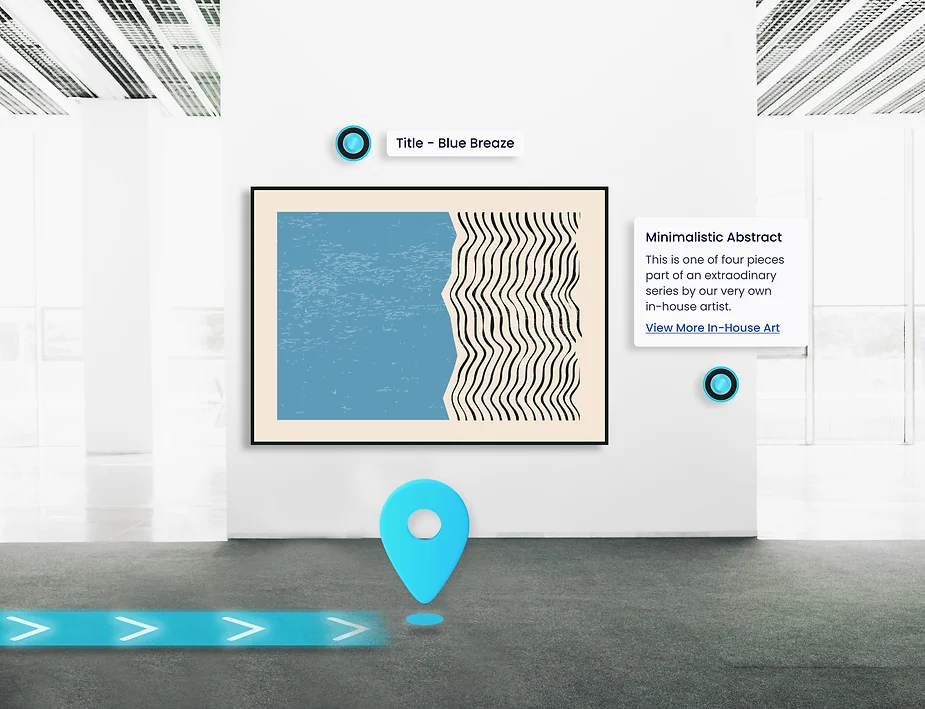
AR navigation path in an art gallery with 2 hotspots describing a painting.

AR navigation path in an art gallery with 2 hotspots describing a painting.

Museums will capture attention with the appeal of interactive ARway Spatial elements on display, but the work doesn’t stop once visitors come in. Large spaces like museums and galleries are prone to navigation difficulties, with 61% of people reporting it as one of their major frustrations. Employees walking around are often stopped for directions to a specific exhibit or visitors are handed paper maps when first entering to help combat the issue, but it’s simply not enough.

By providing ARway’s real-time, interactive MetaMap, museums and galleries can guide users step-by-step to their desired destination or a notable exhibit the museum wants to highlight and push foot traffic towards. AR navigation is 2x faster than 2D navigation using signage, as AR navigation employs text boxes, arrows, and lighted paths to make navigation simple whereas a 2D map isn’t reactive to a visitor’s location and can’t adjust.

Within a MetaMap, museums and galleries can list a directory of all exhibits and let visitors know what art pieces they can expect to find in different areas. Not only is a visitor’s museum experience enhanced by reducing the friction of locating exhibits with AR wayfinding and providing more information, but there is more available information and context by offering curated and self-guided MetaTours of exhibits to further free up employees and improve efficiency. ARway’s MetaMaps require nothing more than a smartphone to scan your environment due to the advanced artificial intelligence technology.

Reduce Costs of Staging and Operating Temporary Exhibits

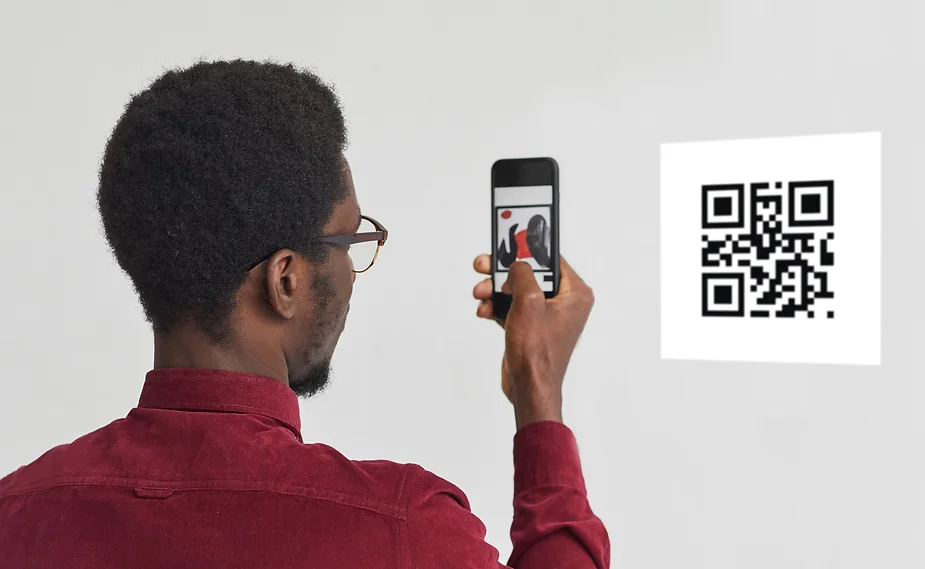
A visitor scanning a QR code and seeing an AR exhibit in front of them.

A visitor scanning a QR code and seeing an AR exhibit in front of them.

A temporary exhibit is an exciting way to generate more foot traffic and buzz around a museum and gallery. However, the temporary aspect means installation, transport and insurance of artifacts, employment of temporary staff and production of audio guides, marketing and advertising of the exhibits, and production and distribution of merchandise. This amount of labor equates to $100,000+ USD to stage and operate an exhibit that runs for around four months. If extensive use of multimedia is involved, it’s $350/ft².

By employing AR via ARways Spatials, MetaTours, and MetaMaps, museums and galleries have the advantage of showcasing thrilling temporary exhibits at a much lower cost. Since AR requires nothing more than a smartphone which an estimated 6.6 billion people own, it’s an incredibly accessible technology. There’s no need for temporary staff and audio guides when a Spatial of the artist narrates and provides context. Marketing becomes AR banners as visitors navigate the MetaMap – there’s an AR application to make the process convenient for museum stakeholders while still being compelling for visitors.

Expand Exhibit Capabilities Beyond Physical Limitations

What visitors to a museum or gallery might not know is that what they see on display is not everything the institution has to offer. The Museum of Fine Arts in Boston, for example, is only capable of displaying 4% of their total inventory at any one time, meaning visitors are missing out on over 400,000 art pieces. There are simply too many physical constraints that prevent everything from being displayed, but AR versions are accessible to visitors at all times. Even pieces and collections that have been lost, destroyed, or can’t be exposed to light have the potential to shine and be explored by visitors.

While a museum or gallery’s ambitions may not line up with their resources, AR technology is a spectacular digital innovation that can even allow institutions to bring in world-famous artwork even on a tight budget. Museums can offer pieces in digital formats, allowing visitors to explore in great detail via their mobile devices.

Implementing AR in artwork enables artists to share stories about their pieces and add an extra layer of context from the source themselves. A Spatial activation of the artist can pop up and reveal a painting’s meaning through written information and tell a story about featured personalities without interference with the exhibition design. They can also reveal what they used to create the colors, and what fabric and frame they chose, which for people who appreciate art and attend exhibitions will be of interest.

Museums and galleries must enter the digital age if they wish to stay relevant to the future generation. Innovative digital AR technology is a great complement to the physical pieces and artifacts we hold great value for.

Interested in adding AR technology to a museum or gallery? Visit ARway.ai to learn more.

We live in a time of unprecedented movement and motion. Whether people are moving across the land, transportation hubs buzzing, ports flush with products coming and going, or fleets of delivery trucks whizzing from place to place, it is a blur of activity and expectation. At the center of all of this are American manufacturers and their warehouse and distribution facilities.

It’s difficult to overstate the centrality of these industries to the US economy. According to the National Association of Manufacturers, the total output for manufacturing was $2.3 trillion in 2020. The National Institute for Standards and Technology reports that the sector employs more than 15 million people – approximately 10 percent of the U.S. workforce.

Warehousing and fulfillment are critical steps in putting products into the hands of customers. According to Capital Counselor, in 2019, Amazon processed 66,000 orders every hour in the U.S. That’s more than half-a-BILLION packages flowing from warehouses to homes and businesses across the country.

This is a complex and multi-faceted operation. Some of the challenges facing the women and men doing this work include finding one’s way within a sprawling warehouse, optimizing product pick-up routes, and confirming that a package picked contains the intended product, among other things. Fortunately, ARway has proven technology that can address these various needs.

ARway’s key capabilities include:

Warehouse Facilities Improved with AR

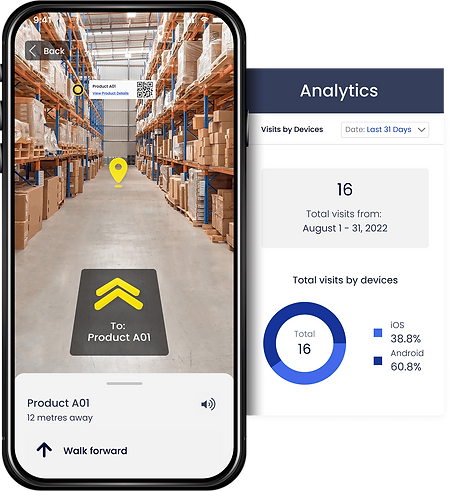
Warehouse aisle – AR navigation leading to a specific product hotspot. Analytics are shown to the right.

These capabilities have a direct and dramatic impact on key areas of manufacturing and warehousing operations:

ARway is giving manufacturers, warehouses, and distributors a clear advantage by making products easier to find, identify, and pull. The most efficient way to move products off shelves, onto trucks, and into customers’ hands is being powered by ARway’s powerful – yet incredibly easy-to-use – augmented reality technology.

If you want to learn more about how ARway and augmented reality are powering the future of American manufacturing and distribution or to start your free trial to see how ARway can help your business, visit ARway.ai

What does an engaged customer look like? Is it simply by talking to employees? Or is it when they hold a product in their hands?

No matter what shape engagement appears in, the bottom line is that if a customer is not engaged and doesn’t know what is being offered, they won’t stay. They tend to walk out of retail stores after briefly scanning items or leave an attraction because they’re unaware, and thus, there isn’t anything worth their attention. But customers don’t want to walk away – in fact, they want to stay and see more. 64% of brick-and-mortar retail customers report limited product information as one of their top pain points.

While it may seem too big of a challenge to keep a customer consistently engaged, augmented reality (AR), specifically location-based AR activations, are incredibly interactive and immersive to establish that ever so important customer connection. Continue reading to learn how Spatials can impact and engage with visitors in the right place at the right time – no matter the industry.

What is Location-Based Marketing and Advertising?

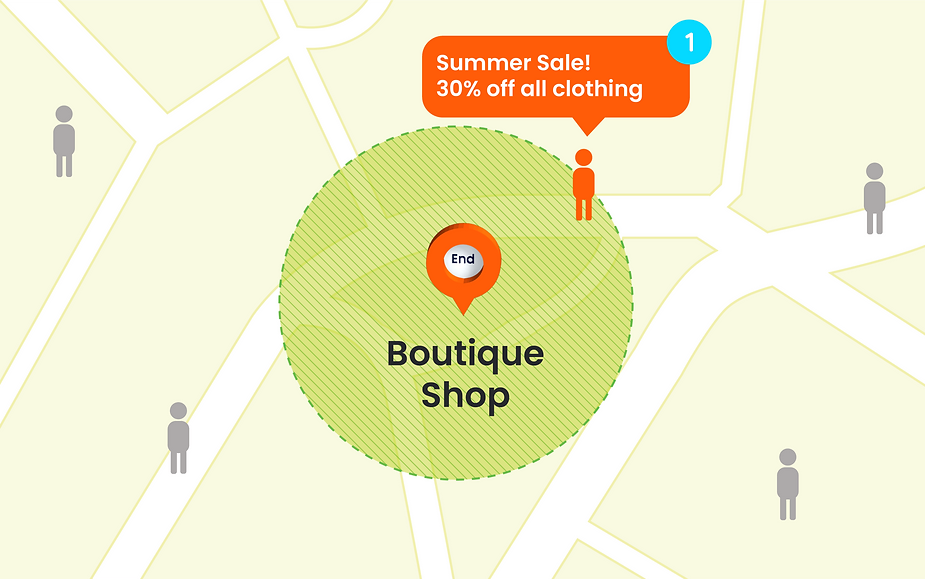
Location-based marketing and advertising is all about getting the attention of consumers nearby. Through mobile marketing, brands can target consumers within a specific geographic area by determining the consumer’s location through GPS, whether it be through an app or a website. For example, if you own a small boutique downtown and are interested in sending out an advertisement to people within 3 miles, you’ve established your geofencing radius and are ready to reach those within the specified location. In turn, you will hopefully generate more foot traffic and interest in your boutique.

Location-Based Marketing

Geofencing radius – customers will get a notification when they are near the store.

How is it Different from Proximity-Based Marketing?

Rather than a business widely casting their net out in hopes of reaching more people, proximity-based marketing takes it to a much more personal level. You can track consumer traffic more precisely, and for example, target based on how long they’ve been considering a certain product on a shelf or a general department they seem to gravitate towards. The implementation of well-timed and relevant content makes for happier and more engaged customers with higher purchase intent.

What are Location-Based AR Activations?

So, now that we know we have the ability to connect with customers close to us through location-based marketing, how can businesses make the most of this opportunity?

AR is the perfect fit to maximize user engagement with the content in their nearby environment. It’s an accessible technology that naturally encourages users to get directly involved, whether it’s by placing furniture in your home to preview its fit or gamification like the revolutionary Pokemon Go app. Its intrinsic and engaging nature has led to increased dwell time by upwards of 2.31 seconds and 39% of users to re-engage with content that has AR elements.

Location-based marketing and AR come together in the form of Spatials. Spatials are location-anchored, persistent AR content and activations that can be interactive and immersive, allowing for a shared presence among visitors. They can be used for countless applications, such as entertainment and gamifications, object and location information, advertising and marketing campaigns, and more to engage with visitors in the right place at the right time.

Using Spatials to Increase Consumer Engagement with their Environment

Retail stores are perhaps one of the best use case scenarios for Spatials. Once people step foot in a store, businesses can encourage users to download their app and start up a scavenger or treasure hunt. A completion can mean gaining a unique coupon code or being entered to win a prize.

Utilizing Spatials doesn’t necessarily always have to equal more sales – it can simply mean promoting a more memorable and enjoyable consumer experience. Take museums and galleries, for example. You want visitors to feel connected and engaged with the artworks on display. According to a Seattle Art Museum (SAM) survey, many participants report wanting to learn more about exhibits, but not having sufficient information available to them.

This problem can easily be solved by displaying 3D personas of a museum representative or the artist themselves to provide a narration, enabling visitors to foster not only a deeper understanding, but also be more engaged.

Opportunities for learning and engaging further with pieces can also be family-friendly. The National Museum of Singapore offers a spin of Pokemon Go and adds in gamification by allowing visitors to hunt and catch for items within paintings. They grow their personal virtual collection while they explore the museum as well as their knowledge; users learn facts such as habitat, diet, and rare species from collecting.

While this museum goes above and beyond in their presentation, any museum can bring a display or art piece to life with a simple Spatial. Visitors can come face to face with extinct animals through a digital representation or traveling to a different century through a painting. By including these details, visitors are proven to linger around attractions longer as studies show 84% of visitors feel more engaged and find an experience more memorable if it has AR elements.

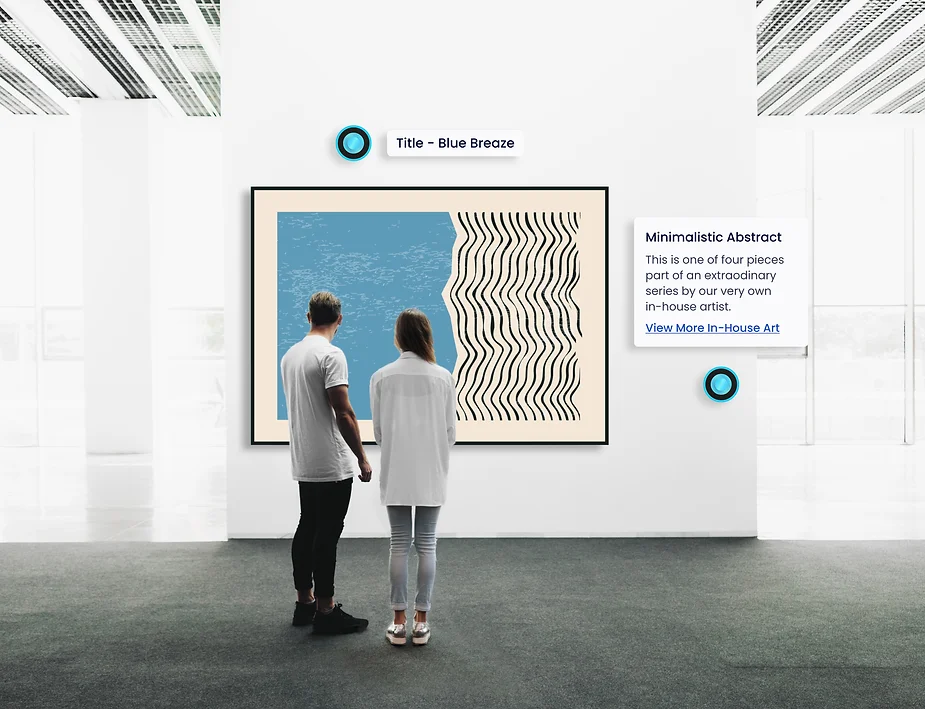
Painting in a gallery with hotspots.

Painting in a gallery with hotspots.

Further, digital AR displays promote an intuitive and flexible environment and provide plenty of benefits from a logistical standpoint with no limitations on space, it eliminates problems like the Museum of Fine Arts in Boston has where they are only able to show off 4% of their total inventory at any one time.

Using Spatials to Create Viral Marketing Campaigns

67% of ad agencies are generating more revenue because of AR. And why not? It’s eye-catching, immersive, and most importantly, different from the other 10,000 advertisements the average person sees per day.

Check out Pepsi Max’s AR experience bus stop campaign that went viral, garnering 8 million views on YouTube, more than 50 million views across campaign videos, and led to a 30% increase in sales of single serving bottles, making Pepsi Max the second biggest UK brand channel by subscription. Passengers waiting for the bus can’t take their eyes off the AR experience, and there’s undeniable joy radiating from them. AR undoubtedly captures people’s attention for longer and gets them to linger. In a busy modern life where most are not inclined to even give a second of their time, spatials are a proven way to metaphorically shake them by the shoulders and say, “hey, look at me!”

Interested in starting your own creative ways to get people to your location? Visit ARWay.ai to learn more about how AR Spatials can transform your visitors’ experience.